- CEIS | POWER
- CEIS | GOVERNMENT
- EXPERTISE
- ABOUT
- CAREERS
- Contact
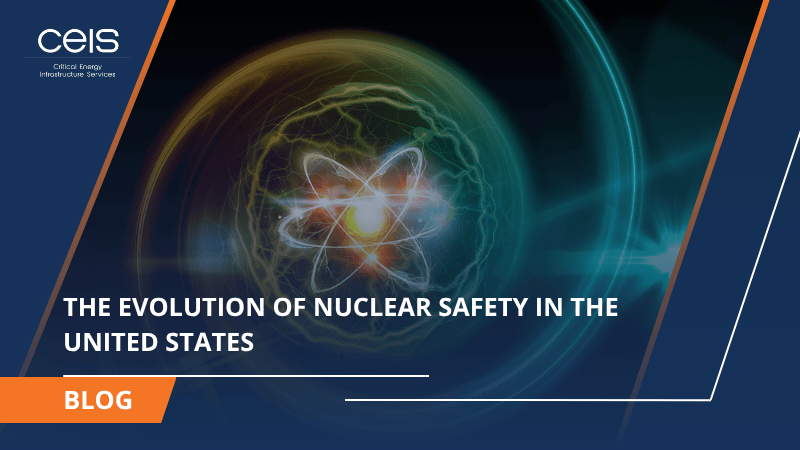
Ever since the invention of nuclear power in the mid-20th century, safety has always been a cornerstone of the nuclear field. What started with the first electricity generated from a nuclear reactor on December 20, 1951, at the Experimental Breeder Reactor I (EBR-I) in Idaho, has evolved into some of the most cutting-edge technology in the energy sector today.
However, this was not always the case. Most Americans still associate nuclear power with the partial meltdown of the Unit 2 reactor at Three Mile Island in March 1979. While that event is often viewed as a defining failure, the reality is far more nuanced. The release of radioactive material was minimal and had no detectable impact on either plant workers or the surrounding community. The incident began when pumps failed to circulate water to cool the reactor core, and a safety relief valve malfunctioned as pressure built within the reactor.
In the aftermath, the industry underwent a profound transformation. Investigations revealed that the accident stemmed from both equipment failure and the operators’ limited ability to assess the reactor’s condition in real time. The resulting recommendations reshaped the industry’s approach to safety—emphasizing redundancy, operator training, and human factors engineering to prevent future incidents.
While nuclear operations are governed by the U.S. Nuclear Regulatory Commission (NRC), the industry has also taken proactive measures to exceed regulatory expectations. The Institute of Nuclear Power Operations (INPO) established safety and performance models that have become the standard across the sector. Together, these frameworks have made U.S. nuclear plants approximately 100 times safer than the NRC’s own safety goals.
Today, the United States operates 94 licensed nuclear power reactors and 31 non-power reactors located at universities and Department of Energy facilities. Beyond energy production, nuclear technology plays a vital role in medicine through radiopharmaceuticals used in thousands of hospitals nationwide. In this way, nuclear safety touches nearly every American, whether through reliable electricity or life-saving medical applications.
Data from the Institute of Nuclear Power Operations further demonstrates the industry’s progress: the severe injury rate stands at roughly 1 percent per 200,000 work hours, exposure levels have remained consistently low for more than a decade, and safety systems are performing at near-perfect levels. These outcomes make nuclear facilities not only safer than coal-fired plants, but also more efficient, with fewer lost work hours due to safety concerns.
Enhanced safety regulations, continuous learning, and a growing body of technical expertise have all contributed to a stronger culture of safety—one that protects workers, the public, and the environment alike.
As interest in nuclear power rises, so too do opportunities in the sector. The Nuclear Energy Institute reports that the U.S. nuclear energy industry directly employs more than 70,000 professionals, with total employment—including secondary jobs—exceeding 250,000 positions. And with ongoing innovation and new plant development on the horizon, experts anticipate continued growth across all disciplines—from engineering and skilled trades to environmental science and project management.
As the evolution of nuclear energy continues, CEIS | Power can partner with you to meet the demands of the future. Contact us to learn more.
CEIS Power specializes in project services and support, providing experienced project teams and hard-to-source professionals for the energy and industrial sectors. Clients benefit from a unique combination of utility and OEM-trained expertise that helps exceed operating and asset management goals while navigating change. Backed by deep experience with one of the largest technical staffing companies in the U.S., CEIS Power is focused on delivering reliable energy and infrastructure solutions.
THE EVOLUTION OF NUCLEAR SAFETY IN THE UNITED STATES | STANDARDS & PROGRESS | CEIS