- CEIS | POWER
- CEIS | GOVERNMENT
- EXPERTISE
- ABOUT
- CAREERS
- Contact
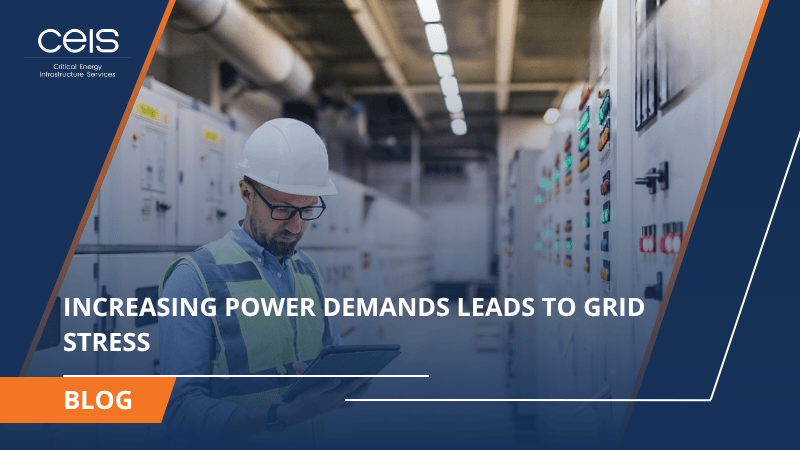
As electricity consumption continues to rise, it is unsurprising that the nation’s electrical grid is under increasing strain. When demand exceeds available supply, the result is brownouts or full-scale outages—events that have become more frequent as energy needs grow.
Rising demand, however, is only one contributor to grid stress. Extreme weather events, including winter storms and hurricanes, place significant pressure on transmission infrastructure and generation assets. When combined with aging transmission systems and supply shortfalls, these factors substantially increase the risk of widespread outages.
Grid stress represents one of the most significant challenges facing the utility industry today and will require innovative, coordinated solutions. While the most obvious response is to generate more electricity, implementing that solution at scale is far more complex than it appears.
The electrical grid encompasses all systems required to generate and deliver electricity to end users. This includes power plants, transmission lines, substations, and the equipment that converts high-voltage electricity into usable power for homes and businesses. Because the grid operates as an interconnected system, the failure of a single component can have cascading effects throughout the network.
Despite frequent references to “the grid” as a single entity, no unified national grid exists. Instead, North America is served by two major interconnections—the Eastern and Western Interconnections—and three smaller systems serving Texas, Quebec, and portions of the Midwest.
This regional structure limits the impact of localized grid failures but also restricts the ability to share power across regions during emergencies. The February 2021 Texas winter storm clearly demonstrated this vulnerability.
During that event, freezing temperatures caused natural gas supply disruptions and equipment failures, significantly reducing generation capacity. At the same time, wind and solar assets were impaired by ice accumulation. More than 4.5 million homes and businesses lost power for several days, resulting in at least $2 billion in economic damage.
Because Texas operates an independent grid largely isolated from the Eastern and Western Interconnections, the state was unable to import power from neighboring regions during the crisis.
Transmission grids are operated by transmission system operators (TSOs)—not-for-profit entities typically owned by utilities within their service territories. TSOs coordinate, control, and monitor grid operations and are required to provide nondiscriminatory access to electricity generators.
Grid reliability in North America is overseen by the North American Electric Reliability Corporation (NERC), a self-regulatory organization composed of industry stakeholders. NERC develops and enforces reliability standards, assesses resource adequacy, monitors system performance, and provides training and accreditation programs to ensure operator proficiency. The organization also investigates major system disturbances to help prevent future events.
According to NERC’s 2025 State of Reliability report, the reliability of North America’s bulk power system (BPS) continues to improve, though significant challenges remain. One growing concern is the rapid increase in electricity demand from data centers. The report notes that a transmission line failure in 2024 resulted in the loss of more than 1,500 MW of power to multiple data centers, triggering large demand fluctuations and placing additional stress on the BPS.
While excess electricity may seem benign, rapid and unpredictable swings in demand can damage equipment and increase the likelihood of outages.
NERC identifies flexibility as the most effective response to grid stress. This includes improving interconnection between regional grids, enabling areas affected by extreme weather to access power from regions with available capacity.
Another effective innovation is the deployment of battery energy storage systems (BESS), which store electricity at utility scale for use during periods of grid stress. In Texas, installed BESS capacity exceeded 10 GW as of December 2024, with an additional 19 GW planned by the end of 2025.
While all utility-scale batteries can provide frequency support, Texas mandates frequency response through a reliability standard. Combined with increased installed capacity, rapid response capabilities, and the ability to operate at partial charge, BESS installations have become a critical component of the Texas Interconnection. In 2024, the Electric Reliability Council of Texas recorded several instances in which batteries supplied 100% of the system’s frequency regulation capacity.
Although electricity demand is expected to continue rising, innovation across the energy sector is helping ensure that grid stress does not impede reliable power delivery.
CEIS brings deep expertise in electrical transmission and distribution, supporting both maintenance and new infrastructure development. As a leader in energy and infrastructure services, CEIS delivers integrated engineering, consulting, and field solutions that strengthen and modernize electrical grids.
CEIS Power specializes in project services and support, providing experienced project teams and hard-to-source professionals for the energy and industrial sectors. Clients benefit from a unique combination of utility and OEM-trained expertise that helps exceed operating and asset management goals while navigating change. Backed by deep experience with one of the largest technical staffing companies in the U.S., CEIS Power is focused on delivering reliable energy and infrastructure solutions.
HYDROELECTRIC POWER IN THE U.S. | DAMS, TURBINES & ENERGY INFRASTRUCTURE | CEIS