- CEIS | POWER
- CEIS | GOVERNMENT
- EXPERTISE
- ABOUT
- CAREERS
- Contact
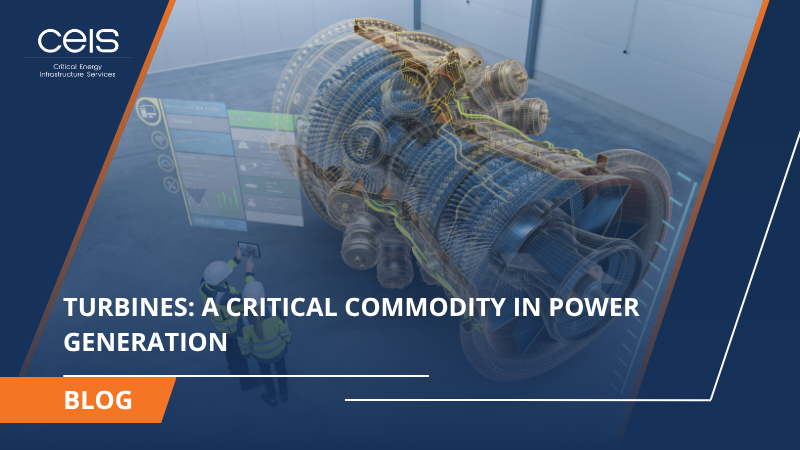
Global demand for electricity is expected to grow significantly over the coming decades. As economies expand, data centers multiply, and electrification accelerates, the need for reliable power generation continues to rise.
With that growth comes a parallel demand for the equipment that makes electricity possible — particularly turbines.
The challenge facing utilities and developers today is not simply demand, but supply. Industry analysts estimate that new turbine orders can take five years or longer to deliver due to global manufacturing backlogs and rising demand across multiple power sectors.
The global turbine market reflects this trend. Valued at roughly $185 billion in 2024, the market is projected to reach approximately $377 billion within the next decade, representing a compound annual growth rate of about 6.7 percent.
Turbines used in power generation generally fall into three categories based on what drives them:
Each plays a critical role in global energy production.
Steam and gas turbines remain the backbone of conventional and combined-cycle power plants. These technologies continue to support baseload electricity generation and grid reliability.
Wind turbines, however, are expected to experience the fastest growth as nations expand renewable energy capacity. Policies such as the European Union’s Green Deal, which targets 42.5 percent renewable energy consumption by 2030, are accelerating investment in wind infrastructure worldwide.
A small number of manufacturers dominate the global turbine market.
In wind energy, companies such as GE Vernova, Vestas, and Siemens Gamesa account for more than two-thirds of installed wind capacity in the United States.
For steam and gas turbines, GE Vernova, Mitsubishi Power, and Rolls-Royce remain among the industry leaders.
Manufacturers are expanding capacity to meet demand. GE Vernova, for example, recently reported a 60-gigawatt backlog and reservation agreements heading into 2026 and has invested in expanding production at its turbine manufacturing facility in Schenectady, New York.
Mitsubishi Power has also announced plans to double global turbine manufacturing capacity over the next two years.
Even with these expansions, however, supply constraints remain significant.
Across the industry, turbine delivery backlogs now average five years or more.
While manufacturers are working to expand production, analysts caution that increased manufacturing capacity may simply keep pace with growing demand rather than eliminate delays.
For utilities, developers, and infrastructure planners, this means long-term planning has become essential. Project timelines must account for turbine availability, manufacturing schedules, and supply chain constraints.
The good news is that turbines are designed to operate for decades.
Modern turbines are engineered with flexibility in mind, allowing operators to adapt to changing fuel sources and technological improvements. Over the past two decades, many power plants have transitioned from coal to natural gas, and turbine designers are now building systems that can be adapted to future innovations.
As a result, many of the turbines installed today are expected to remain in operation 30 years or more, making them one of the most durable and valuable assets in the power generation industry.
CEIS Power is rapidly emerging as a trusted partner in power generation and energy infrastructure. Our team brings deep expertise in turbine systems, plant operations, and grid infrastructure.
Through integrated engineering, consulting, and field services, CEIS supports utilities and infrastructure operators in maintaining reliable power generation and modernizing critical energy assets.
CEIS Power specializes in project services and support, providing experienced project teams and hard-to-source professionals for the energy and industrial sectors. Clients benefit from a unique combination of utility and OEM-trained expertise that helps exceed operating and asset management goals while navigating change. Backed by deep experience with one of the largest technical staffing companies in the U.S., CEIS Power is focused on delivering reliable energy and infrastructure solutions.
TURBINES IN POWER GENERATION | DEMAND, SUPPLY & INFRASTRUCTURE TRENDS | CEIS