- CEIS | POWER
- CEIS | GOVERNMENT
- EXPERTISE
- ABOUT
- CAREERS
- Contact
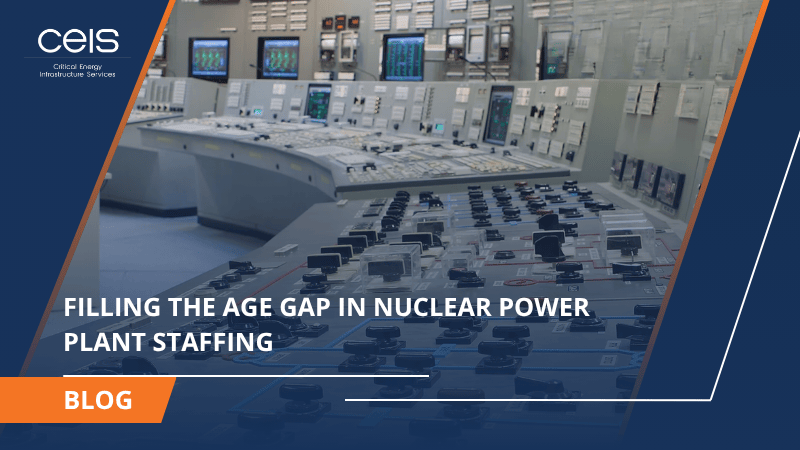
Staffing a power plant is challenging under any circumstances — but nuclear facilities present a uniquely complex workforce equation.
According to the U.S. Department of Energy, nuclear utilities employed approximately 41,000 workers in 2023. With new reactors under construction and previously shuttered plants restarting operations, workforce demand is expected to grow steadily. The concern is not job availability — it’s whether the industry can fill these highly specialized roles fast enough.
Across the broader energy sector, talent shortages are common. However, nuclear faces a sharper demographic imbalance. Roughly 60% of nuclear plant employees are between the ages of 30 and 54, while the sector has 23% fewer workers under age 30 compared to the overall energy workforce. This age distribution signals a looming wave of retirements — without a proportional pipeline of early-career professionals ready to step in.
The “skills gap” affects nearly every industry, but it is particularly acute in nuclear energy. Many plant roles require advanced technical training, certifications, and federal licensure. As technology evolves and plants modernize, workforce development has struggled to keep pace.
Several factors contribute to the challenge:
At the same time, many employers have prioritized immediate staffing needs over long-term talent investment. Hiring already-qualified professionals is often viewed as faster than developing new ones — but that strategy is increasingly unsustainable.
The nuclear industry is responding with a two-pronged strategy.
First, experienced professionals are being encouraged to delay retirement or return in mentorship roles, creating continuity while institutional knowledge is transferred.
Second, plant operators, unions, and industry partners are renewing investments in recruitment and workforce development. Internship programs, structured entry-level pathways, and stronger engagement at career fairs are regaining momentum. The focus is shifting from simply hiring skilled workers to actively developing them.
Licensure and certification pathways are also becoming more accessible through employer sponsorships, structured training programs, and online coursework. While some employers once feared that trained workers might leave for competitors, many are now investing in retention strategies that emphasize competitive compensation, advancement opportunities, and strong workplace culture.
The future of nuclear energy depends not only on technology and policy — but on people.
CEIS Power is rapidly emerging as a trusted partner in nuclear power plant support and staffing expertise. Our team understands the operational, regulatory, and technical complexities unique to nuclear facilities. Through integrated engineering, consulting, workforce solutions, and field services, CEIS delivers the specialized support utilities need to operate safely, efficiently, and reliably.
CEIS Power specializes in project services and support, providing experienced project teams and hard-to-source professionals for the energy and industrial sectors. Clients benefit from a unique combination of utility and OEM-trained expertise that helps exceed operating and asset management goals while navigating change. Backed by deep experience with one of the largest technical staffing companies in the U.S., CEIS Power is focused on delivering reliable energy and infrastructure solutions.
NUCLEAR STAFFING SHORTAGE | WORKFORCE GAP IN POWER GENERATION | CEIS