- CEIS | POWER
- CEIS | GOVERNMENT
- EXPERTISE
- ABOUT
- CAREERS
- Contact
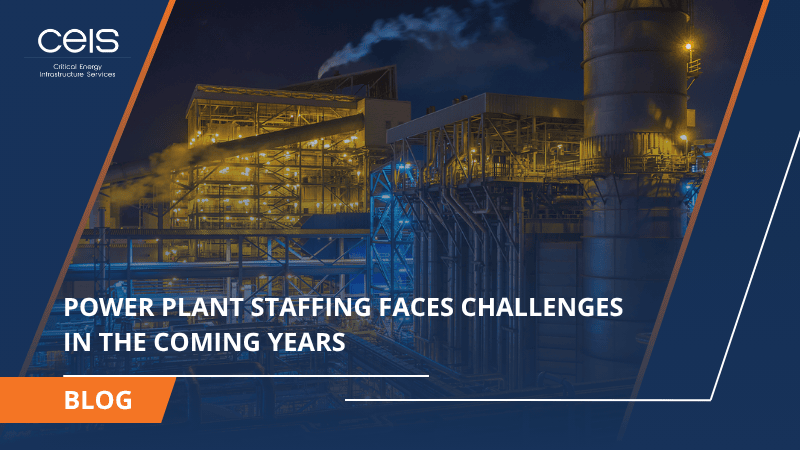
A perfect storm is forming in the staffing landscape for power plants.
Although the total number of power plant jobs in the U.S. is projected to decline by 10 percent over the next decade, the industry will still require an estimated 3,800 new workers each year. Filling those positions may prove challenging, industry experts warn.
The reasons are straightforward: a rapidly aging workforce nearing retirement and a shortage of skilled workers prepared to take their place.
Industry experts agree that the shrinking number of positions in power plants is largely the result of technological advancements, which have made facilities more efficient and less labor intensive.
By 2024, coal-fired plants generated only about 15 percent of U.S. electricity—down from 35 percent in 2015. Since 2010, 289 coal plants have been retired and replaced by renewable energy sources such as wind and solar or by plants fueled by natural gas and nuclear energy.
Between 2011 and 2019, the U.S. Department of Energy reports that 121 coal plants were converted to operate on alternative fuels.
Along with these conversions has come an expansion of automation. A legacy coal plant might require up to 170 employees, whereas a modern gas-fired plant can operate with a staff of roughly 35.
The reduction in staffing began in the 1990s as plant owners sought to reduce costs. Automation eliminated many skilled positions—but it also led to the loss of institutional knowledge as experienced workers exited the industry.
According to the Bureau of Labor Statistics, approximately 47,000 individuals work in U.S. power plants, and about half of them are expected to retire within the next decade.
Despite decreasing job numbers, many positions will still need to be filled. What concerns the industry even more is the loss of expertise that accompanies these retirements.
More than 70 percent of the U.S. power grid is at least 25 years old. Veteran workers understand these legacy systems, know how to troubleshoot complex issues, and bring historical context that cannot be easily replaced.
Experts warn that this impending knowledge gap will place significant stress on plant operations and reliability.
The “skills gap” is affecting nearly every industry, and power generation is no exception. Technological advancements have accelerated faster than the training of new workers. Other contributing factors include limited training programs, reduced union apprenticeship opportunities, stagnant recruiting efforts, and inconsistent investment in long-term workforce development.
This has fueled misconceptions that “young people don’t want to work,” but the real issue is a lack of structured pathways into the industry. Many employers focus on immediate staffing needs rather than long-term talent cultivation.
Compounding the challenge is the perception that energy-sector work is unappealing. Training can be costly and difficult to access, jobs are often located in remote areas, and younger workers who prioritize sustainability may hesitate to pursue careers in traditional energy roles.
Despite these challenges, the industry is making progress in rebuilding its workforce.
Many skilled power plant positions require certification—traditionally a costly and time-consuming pursuit for individuals. However, union halls and plant owners are increasingly investing in training new interns and entry-level employees rather than exclusively recruiting experienced workers.
Recruitment efforts at high school and college career fairs, once largely abandoned, are making a comeback as effective channels for attracting young talent.
Companies are also developing programs to help new workers obtain the certifications they need, with online coursework and testing making training more accessible than ever.
While some plant owners fear that newly trained workers may leave for other opportunities, many employers are responding with retention strategies. These include competitive compensation, improved benefits, opportunities for advancement, and investments in creating supportive, positive work environments.
CEIS has a team of experts who specialize in boiler maintenance, inspection, and renovation. We are leaders in energy and infrastructure services, delivering integrated engineering, consulting solutions, and field services for turbines, boilers, and balance-of-plant systems.
CEIS Power specializes in project services and support, providing experienced project teams and hard-to-source professionals for the energy and industrial sectors. Clients benefit from a unique combination of utility and OEM-trained expertise that helps exceed operating and asset management goals while navigating change. Backed by deep experience with one of the largest technical staffing companies in the U.S., CEIS Power is focused on delivering reliable energy and infrastructure solutions.