- CEIS | POWER
- CEIS | GOVERNMENT
- EXPERTISE
- ABOUT
- CAREERS
- Contact
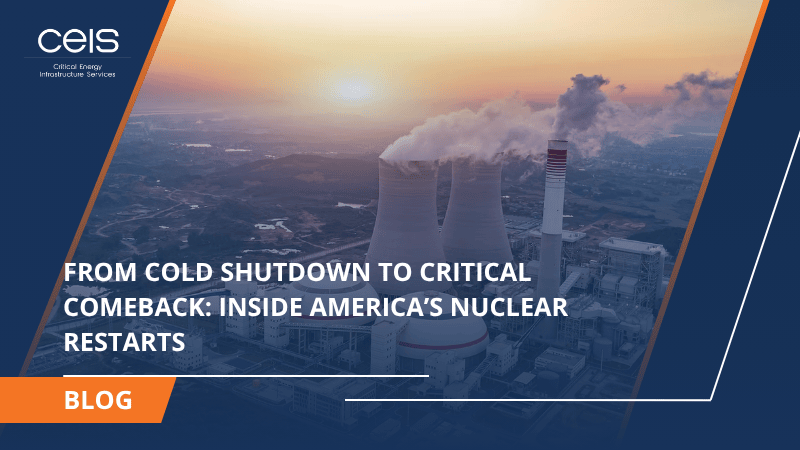
The United States has been a global leader in nuclear power since the industry’s birth in the 1950s. Today, 94 commercial reactors are operating nationwide—and that number is poised to grow. While 13 new plants are in the planning or construction phases, much of the industry’s attention is focused elsewhere: the restart of reactors once thought permanently offline.
Five previously shut-down reactors are now being evaluated for restart, a notable development given that the U.S. has an inventory of 15 reactors that have ceased operations, with others fully decommissioned. The renewed interest reflects shifting energy realities and a reassessment of nuclear power’s long-term value.
Decommissioning is a permanent process involving the removal of nuclear fuel, dismantling contaminated systems, and disposing of materials in accordance with strict regulations. A shutdown, by contrast, simply halts power production. It differs from an outage, which is a temporary interruption for maintenance or emergencies.
Commercial reactors are licensed by the U.S. Nuclear Regulatory Commission (NRC) for 40-year terms, though many licenses have been extended. Plant operators must submit a decommissioning plan and cost analysis within five years of license expiration, and regulations require decommissioning within 60 years of a plant stopping operations. Currently, 15 commercial reactors are shut down and in various stages of decommissioning.
Rising electricity demand—driven in large part by data centers—and advances in technology are changing the calculus. A prime example is the Duane Arnold Energy Center near Cedar Rapids, Iowa. Shut down in 2020 and headed toward decommissioning, the plant took a dramatic turn in late 2025 when majority owner NextEra Energy Resources reached an agreement with Google to restart the facility by 2029 to power data centers.
Modernization is another driver. In January 2026, the NRC approved the first large-scale digital modernization of the Limerick Clean Energy Center in Pottstown, Pennsylvania. Constellation Energy’s upgrade of its two reactors is expected to improve reliability, enhance diagnostics, and strengthen cybersecurity—demonstrating how upgrades can extend plant life rather than end it.
Restarting a nuclear facility is anything but simple. It begins with developing a comprehensive plan that satisfies NRC requirements—a process made more daunting by the fact that only one reactor has previously been approved for shutdown, major modification, and restart. As more examples prove successful, however, industry confidence is growing.
Staffing is another major hurdle. Once a plant shuts down, much of the workforce is laid off, and rehiring qualified personnel is challenging. Control room operators, for example, must be licensed for specific reactors, often requiring separate certifications for multi-unit plants.
Beyond staffing, operators must address deferred maintenance and modernization backlogs, implement robust asset management programs, procure nuclear fuel, and secure customers for the electricity generated. Each step adds complexity, time, and cost.
Nuclear power’s rigorous regulatory environment can make restarts feel slow—but those safeguards are essential to ensuring safe, reliable operations. Thorough oversight is not an obstacle; it’s a prerequisite for public trust and long-term success.
CEIS Power is rapidly emerging as a leader in nuclear power expertise. Our team brings deep knowledge of nuclear plant operations, regulatory requirements, and modernization strategies. Through integrated engineering, consulting, and field services, CEIS supports nuclear facilities and the electrical grid with the experience needed to move confidently from shutdown to restart.
CEIS Power specializes in project services and support, providing experienced project teams and hard-to-source professionals for the energy and industrial sectors. Clients benefit from a unique combination of utility and OEM-trained expertise that helps exceed operating and asset management goals while navigating change. Backed by deep experience with one of the largest technical staffing companies in the U.S., CEIS Power is focused on delivering reliable energy and infrastructure solutions.
NUCLEAR PLANT RESTARTS IN THE U.S. | MODERNIZATION, STAFFING & REGULATION | CEIS